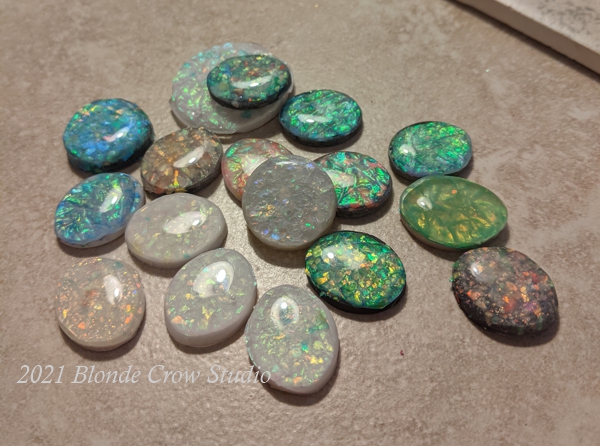
Before I ever created these faux opals, I fell headfirst into a worldwide opal rabbit hole. I studied gems from Australia, Ethiopia, Mexico, and beyond, searching for the secret behind those impossible flashes of color. But I kept returning to the opals of Coober Pedy, Australia- a scorching mining town where more than half the residents escape the desert heat by living underground in converted homes, churches, hotels, and shops carved into the earth. They. Live. Underground.
Of course, recreating opals in polymer clay turned out to be slightly easier said than done. My journey involved years on and off experimenting, tweaking, layering, and collecting enough failed attempts to build my own tiny polymer clay mountain range. Some samples were promising. Most were “creative learning experiences.”
My eureka moment happened when I stopped trying to imitate the appearance of an opal and zen-fully became one with the opal. Just kidding. I read books, and it turns out that Mother Nature is a brilliant little optical engineer. Natural opals begin their lives when water travels through cracks in sandstone, carrying tiny silica particles deep underground. As the water slowly evaporates, it leaves behind millions of microscopic silica spheres arranged in orderly layers. Those tiny structures act like a diffraction machine—capturing, bending, and bouncing light until the stone erupts with that famous shifting rainbow “play of color.”
By combining translucent polymer clay with simple materials that reflect and scatter light, I was able to recreate the illusion of an Australian opal’s glow, at least it’s really close. No mining equipment. No underground house.
Last September, I shared my faux opal adventure step-by-step with my polymer clay guild. Now, I’m bringing the experiment out my above ground clay room to share my own little piece of opal magic.